One in-store experience, launched in 560 Apple stores three weeks early.
In 2020 Apple introduced AirPods Pro through a guided in-store experience across Europe, Latin America, Asia, Australia and New Zealand, and Canada. Stores were restricted by the pandemic and no one could check the work on site. James E. Coleman was the Integrated Producer in Apple Marketing Communications from April 2020 to January 2021, and owned delivery across eleven organizations.
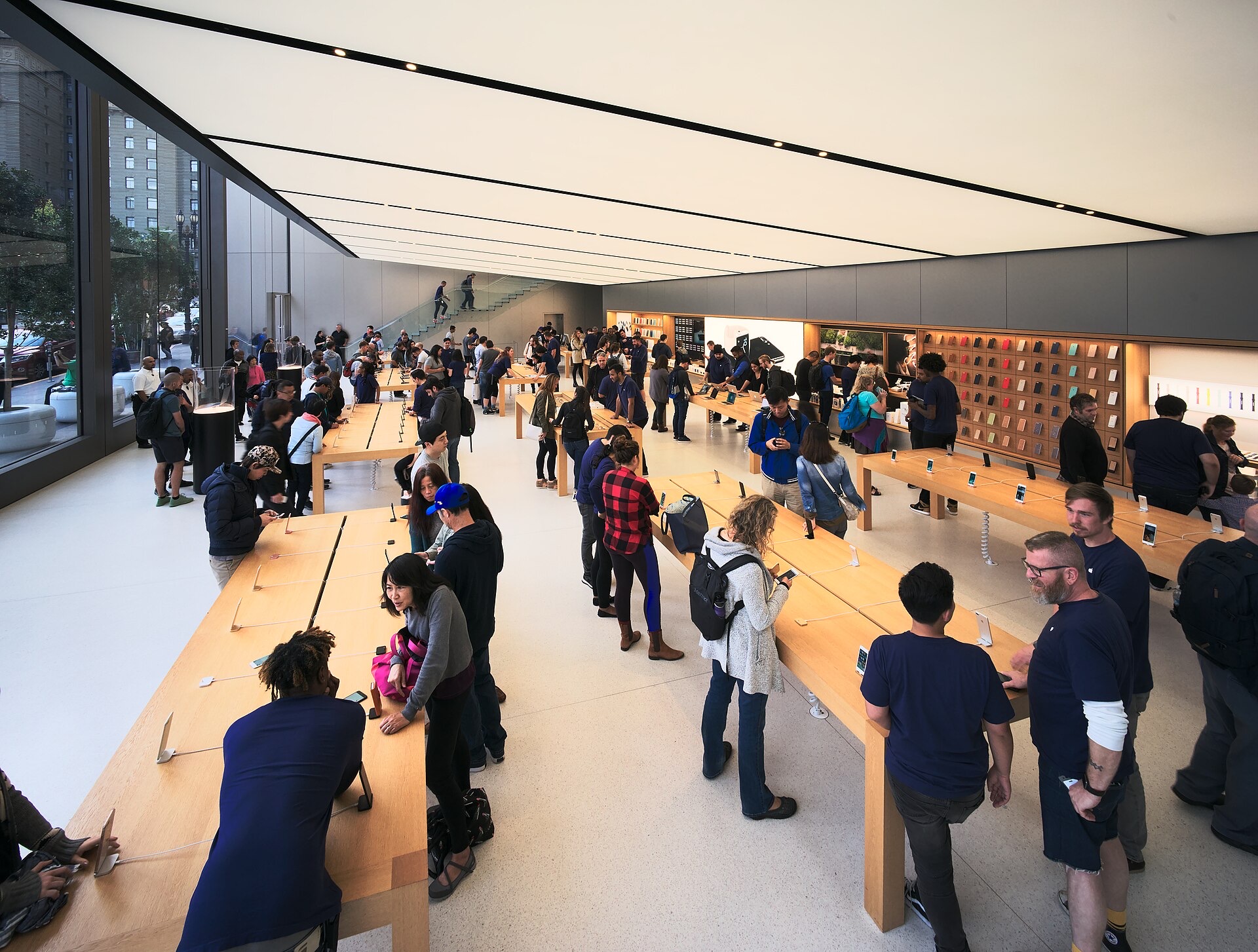
Apple Store, Chengdu. Footage from Pexels. Still: H Burke, CC BY 2.0.
The experience was recognized inside Apple, at the executive level, as one of the most impactful in-store experiences the company had delivered. The three product lines were AirPods, AirPods Pro and AirPods Max.
Validated from one store, with no one inside it
The plan could not cover every market in person. One store with two languages was used to prove the part most likely to fail, and the result was then released everywhere.
No one was allowed inside a store to check the work. Stores were restricted in 2020, so the experience could not be checked on site in any market and had to be validated remotely.
One bilingual store stood in for every market. The Toronto store runs in English and French, so the language toggle of the experience app could be validated there. It was checked on a custom iPad configuration, with no one on site.
The same build then went to all 560 stores. With the toggle proven in two languages, the experience was released to every store. Engineering pushed updates and new prices remotely as market conditions changed.
Two methods were run together
The delivery was a hybrid of two methods. Design kept its fixed stages while engineering shipped in short rounds, and that difference is where the three weeks came from.
Design, in fixed stages
The design team worked in waterfall. Each stage was finished and signed off before the next began.
Engineering, in short rounds
Engineering ran agile rounds with continuous integration and deployment, so each round ended in a build that could ship.
Updates pushed to the stores
Updates and new prices went to the 560 stores remotely as market conditions changed, with no one on site.
The experience the stores ran
Apple’s Marketing Communications team designed the in-store demonstration as a guided moment with the product. The delivery had to put that same moment in every store, in every language.
It opens on the product working
The demonstration starts with one-tap pairing, noise cancellation and spatial audio, so a customer hears the product before any feature is named.
A custom iPad guides it
The tablet cues each capability in turn, including adaptive transparency and the noise-control toggle, with nothing for the customer to set up.
It is told as a story
The experience places AirPods in a commute, a workout or a call, and does not read out a list of features.
It is the same in every market
The words and the gestures had to match across 560 stores, whether the toggle ran in English or in French.
The market the launch supported
These are public figures for the size of the business the launch served. They describe Apple’s segment and third-party estimates, and none of them is a result of this work.
$13.0B
Revenue of Apple's Wearables, Home and Accessories segment in the quarter ended December 26, 2020. It was a record, 30 percent above the year before.
$12B estimated
AirPods revenue in 2020, by third-party estimate, up from about $7.3B in 2019. Apple does not report AirPods revenue on its own.
71%
Share of all revenue from true-wireless earbuds that went to AirPods in 2019, by Counterpoint's estimate.
$13.0B
Revenue of Apple’s Wearables, Home and Accessories segment in the quarter ended December 26, 2020. It was a record, 30 percent above the year before, shown as the outlined bar.