3 wk ▲ early
Apple’s AirPods in-store experience reached 560 stores in five regions three weeks ahead of plan, run remotely across nine teams that did not report to me.
AirPods case study →Strategic designer, builder, and team leader. Helping research-driven and high-tech organizations turn a flood of data into decisions, and decisions into products, programs and launches that reach real people on a real date. Hands-on build and design from concept to GTM.
Advice is cheap until it has a delivery date. Four results, each drawn the way a trading desk would draw it, and each one links to the full case.
3 wk ▲ early
Apple’s AirPods in-store experience reached 560 stores in five regions three weeks ahead of plan, run remotely across nine teams that did not report to me.
AirPods case study →40+ → 5
Southern California Edison’s Charge Ready application went from more than 40 fields to five guided steps, on a $436M program where only 97 of 3,291 applications had been finished.
SCE case study →20+ people, 1 release
A team of more than 20 across Icon, Middleby and Sonic Drive-In shipped the software brain for autonomous cooking robots, from concept to rollout readiness.
Lab2Fab case study →17 papers, 306 min
Seventeen Field Dispatches on AI, organizations and decision systems. Each bar is one paper, as tall as its reading time. Pick one and start.
Browse the research →Ten engagements, from a 560-store Apple launch to an LLM reference platform benchmarked against five Frontier LLMs. Every one has a full case study behind it.
A design-and-research practice and the public reference work behind it. Forty models in one schema, a Studio that benchmarks five Frontier LLMs against a hand-written cloth solver, an ECG trace and a breach kill chain, and a how-it-works page that teaches the decision framework. Open-weights-first, methodology on the page.
 02
Custom Image is a 501(c)(3) trade school in South Los Angeles that teaches six manufacturing trades and generative AI design. Admissions, live video classes, self-paced theory, a design studio and online giving were built for it in fifteen weeks.
 03
Starts from an organization’s own facts, finds its capital across grants, contracts and cooperative agreements, and keeps a human on every trust-critical step.
 04
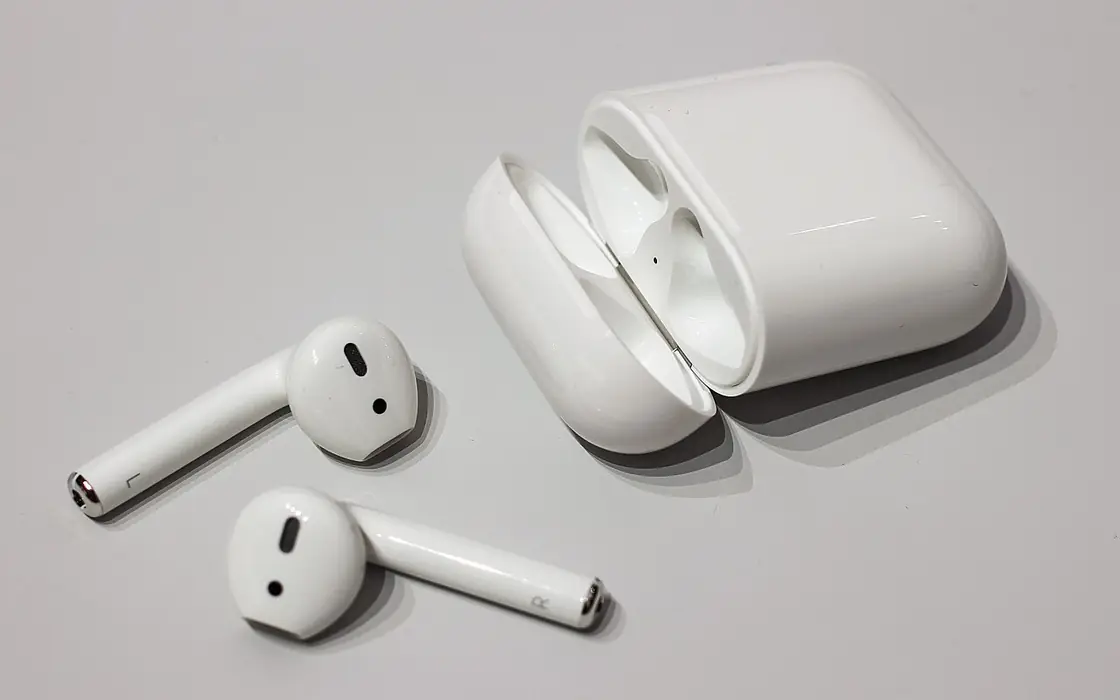
Owned delivery of Apple’s global AirPods in-store experience: five regions, nine cross-functional teams and three product lines, run remotely.
 05
Discovery and solutions strategy for the Google Store, through BASIC: interviews across the business, twenty need categories narrowed to five, and five customer journeys built with the client team.
 06
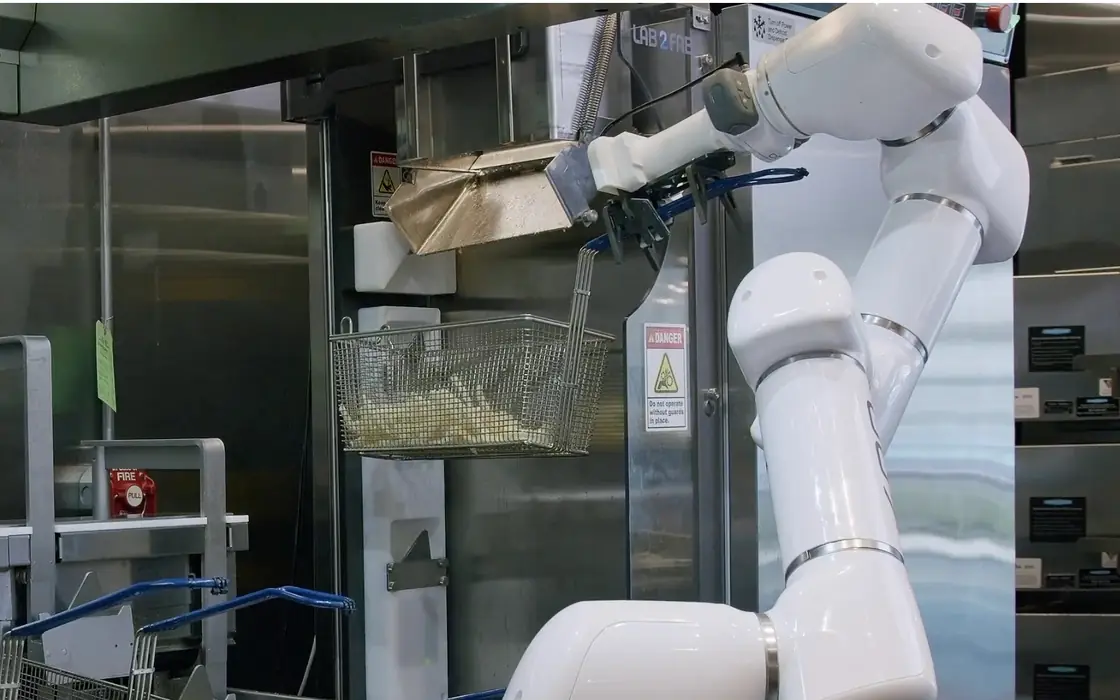
The software brain for Middleby’s autonomous cooking robots, taken from concept to rollout readiness for Sonic Drive-In as senior program manager.
 07
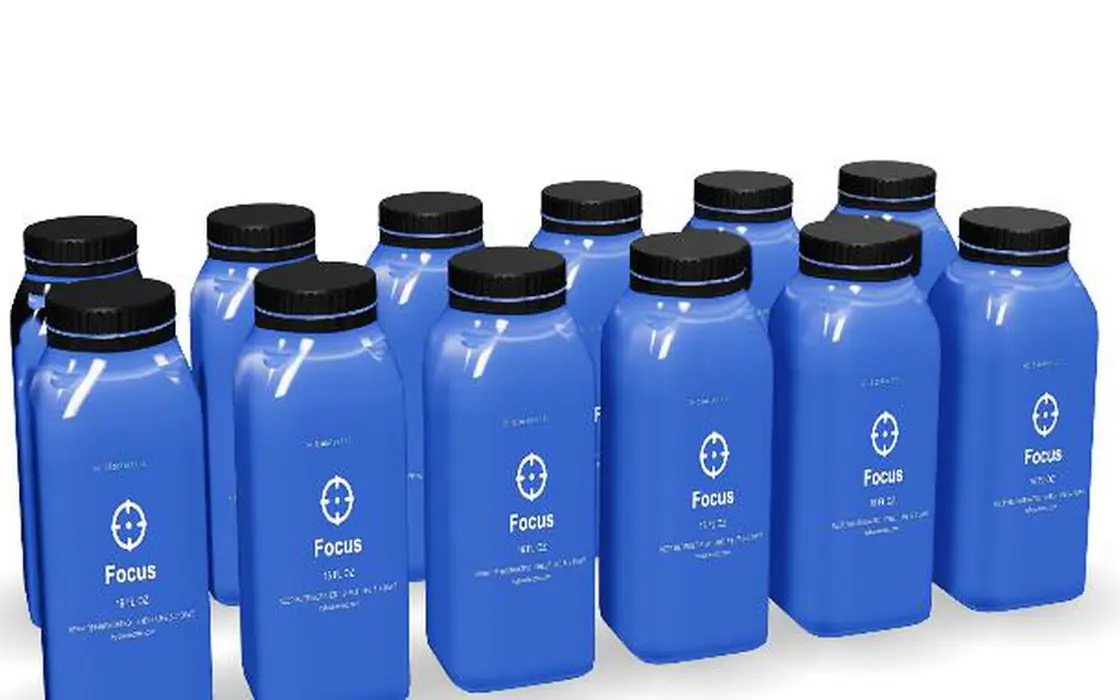
A twelve-formula cold-pressed line with a live formulator that turns nutritional science into something a customer can read at a glance.
 08
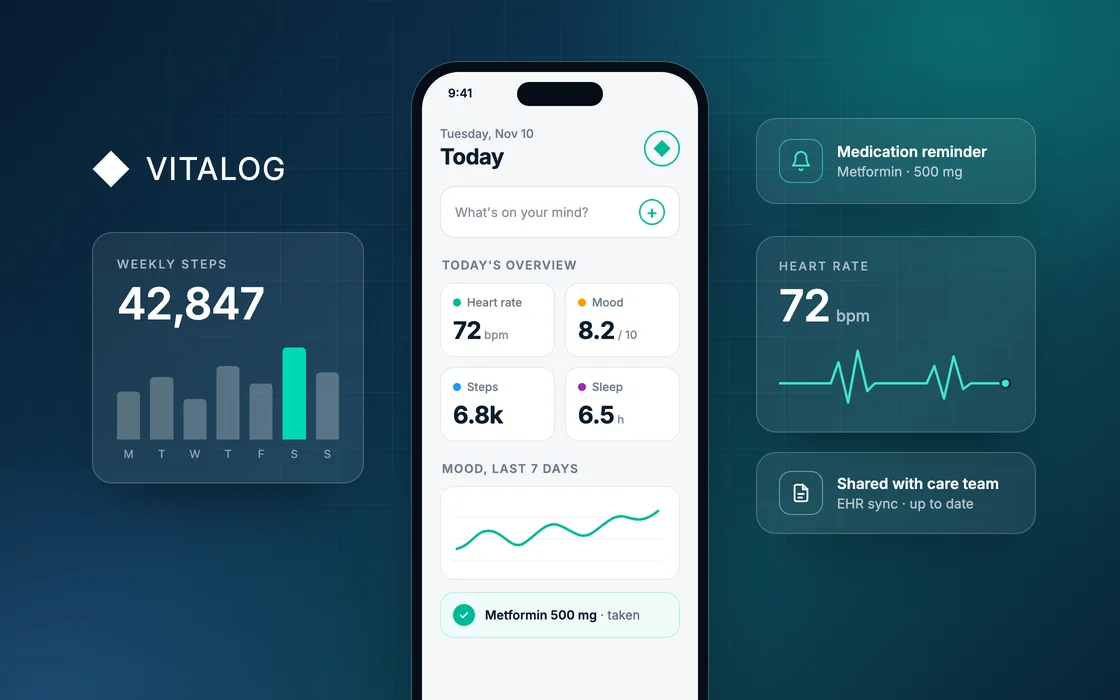
Health journaling redesigned as a daily practice. Led the product design and the brand strategy behind it.
 09
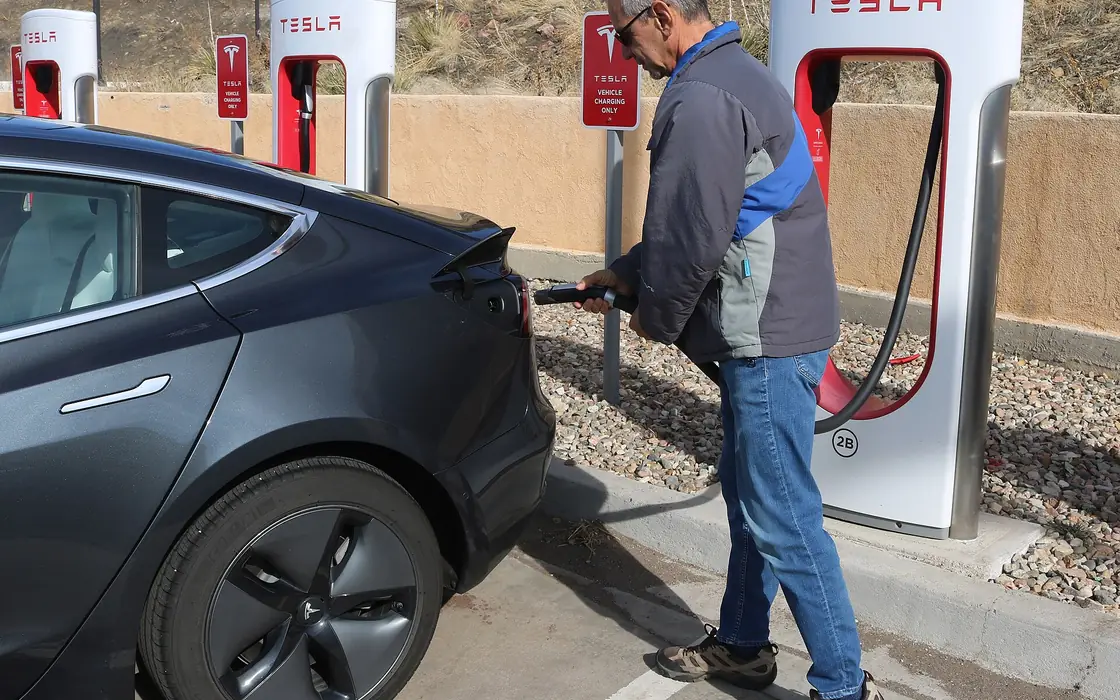
A new build, not a redesign: the Charge Ready PDF application became a handset application, and more than 40 fields became five clear steps, with $75K incentives shown before anyone applies. Quigley-Simpson was the agency lead for Charge Ready.
 10
Canyon Oaks tapped HumanData and James E. Coleman for government relations and FOIA-based intelligence on public stadium operating models, after a civil grand jury asked what the stadium’s non-NFL events should earn. The same question is now a product, Deep Venue.
Drivemode Pulse, a working pitch →How it all ships: CI/CD →Earlier work, 2008 to 2013 →
The tape I keep open while I write. Tokenized assets are where capital formation, trust infrastructure and AI now meet, so the research starts with what the market is doing today.
A journal of AI, organizations and decision systems. Seventeen papers so far, written for the people who have to make the call, with every outside figure traced to its source.
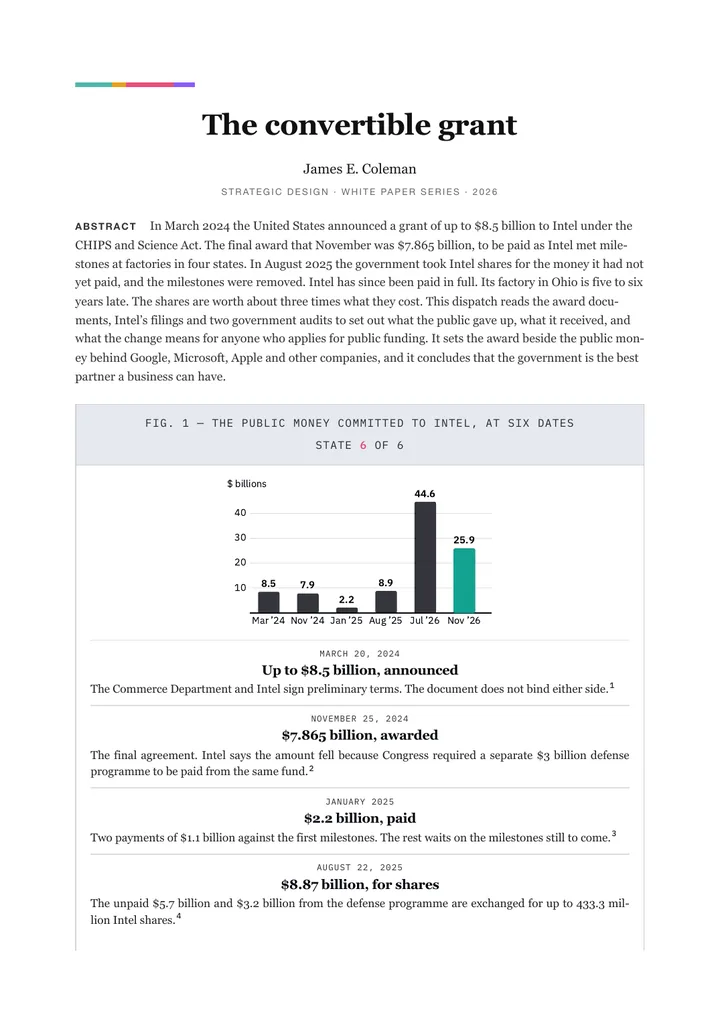
In March 2024 the United States announced a grant of up to $8.5 billion to Intel under the CHIPS and Science Act. The final award that November was $7.865 billion, to be paid as Intel met milestones at factories in four states. In August 2025 the government took Intel shares for the money it had not yet paid, and the milestones were removed. Intel has since been paid in full. Its factory in Ohio is five to six years late. The shares are worth about three times what they cost. This dispatch reads the award documents, Intel’s filings and two government audits to set out what the public gave up, what it received, and what the change means for anyone who applies for public funding. It sets the award beside the public money behind Google, Microsoft, Apple and other companies, and it concludes that the government is the best partner a business can have.
Nvidia put CUDA on a games card in 2006. For ten fiscal years the business it created rounded to zero billion dollars, while research spending rose through two years of losses. Twenty annual reports show what the wait cost, who built CUDA, and which part was Jensen Huang’s doing.
Jensen Huang led Nvidia for 33 years and resigned in four days. What the filings show was in place the day before: a passing mention of losing its leaders, no chair, no deputy, no named successor, 3.58 percent of the votes, and $289 billion promised across the AI supply chain.
Anthropic’s AI now writes more than nine-tenths of its maker’s code, by the company’s own filing. What the S-1 says about the product, the founders, the early money, the two shares that hold control, and the companies repriced in its path.
Nvidia’s flagship AI processor carries the name of David Blackwell, a mathematician the universities that trained him would not hire. Where the name came from, what the mathematics does, and an evidence-graded account of the machines since.
Small businesses are America's job engine and the original issuers where breakthroughs are born, yet private capital pools at the top and seldom flows back to Main Street.
Put enough language models in one room and they behave like a crowd. Under stress, a small fixed minority can pull the whole group toward an extreme.
American companies are routing real workloads to Chinese open-weight models on cost. Where the weights run, not where they were trained, decides whether the data leaves.
Private AI that runs on hardware you control, and why the memory chip, not the GPU, is what finally makes it possible.
How a society manufactures confidence among millions of strangers who will never meet. At that scale trust is designed, collective infrastructure.
The lasting advantage is a system that gets better at getting better. Most organizations reset their capability each cycle; a few close the loop.
What you measure reshapes what you get, yet most measurement systems are inherited by default and not designed with intent.
Advantage goes to the organizations that design AI to complement human judgment, not to whoever automates the most.
Better dashboards do not produce better choices. Decision-making is an architecture that can be engineered to cut bias and noise.
Rapid transaction and deep trust run on incompatible timescales. Organizations that do not design for both sacrifice one to the other.
Promising discoveries are lost because the infrastructure to carry them from discovery to application does not exist, not because they lack merit.
Why most organizations are drowning in data and starving for insight, and the structural conditions that make this the default.
Series to date, Nos. 1 to 17257 pages331 sources
One person does the research, the design and the build, hands on, from the data you already have to the product, experience and organization it should become. See all services →
Turn raw data into computable, trustworthy intelligence that changes how the organization decides, with AI adopted at the pace your maturity can carry.
Move from insight to launch with less risk and a shorter path to value. Market validation first, then a product vision built to be executed.
Design the experience as a system that moves satisfaction, retention and lifetime value, across every touchpoint in the journey.
Work alongside the C-suite to turn transformation ambition into durable organizational and operational change.
Four phases, in the same order every time. Each one ends with something that can be held, drawn here beside a case from the record where it was made.
The problem is studied at its source: the people who run the work, the records and the data.
Ends withA map of the problem
Google Store: interviews and journey mapsThe findings become a plan that names what to build first, and the reason for the order.
Ends withA plan in order of priority
Levi’s Stadium: a framework for the boardThe plan is built as working software, in short rounds that the client can test.
Ends withA working build
Custom Image: 145 commits in one buildThe build is released, watched and handed over, so that it keeps running without its builder.
Ends withA system in service
How it ships: 222 automated deploysThe bars under the third drawing are the commits made in each week of the Custom Image build, from July 30 to November 11, 2026. The other drawings are diagrams.
Where the work has been done, and what the press wrote about it.
James E. Coleman works at the point where data intelligence, product design and program delivery meet. He has owned a global retail launch for Apple, led the software program for autonomous kitchen robots, rebuilt a utility’s enrollment portal for a $436M EV-charging program, and founded HumanData to help organizations find public funding. Before that he produced digital work for BMW, MINI, FedEx, Google and Conservation International, and the Emmy-winning Oscars.com experience for Disney/ABC. He writes the Field Dispatches research series and takes on client work directly.
| Apple | Integrated Producer, Marketing Communications | 2020–21 |
|---|---|---|
| Icon Group | Senior Program Manager, Lab2Fab kitchen robotics | Middleby × Sonic |
| SCE | Lead Consultant, Experience Design Director. Agency lead: Quigley-Simpson | 2015–16 |
| HumanData | Founder & Product Architect | Public funding |
| Custom Image | Strategic Design & Workforce Activation | South LA |
| AltspaceVR | Acquisition advisory to Microsoft on immersive social-platform strategy | 2017 |
TechCrunch2017
Acquisition advisory to Microsoft on immersive social-platform strategy.
SCE Newsroom2016
Cleared to install up to 1,500 EV charging stations across the Southland, the program behind the Charge Ready enrollment portal.
PCWorldCES 2015
PCWorld’s editors named AltspaceVR’s hands-on social VR a standout of the show.
| Oscars.com | Emmy-winning Oscar Digital Experience: the live, multi-camera All Access broadcast companion for Disney/ABC Television Group and the Academy | 2011 |
|---|---|---|
| BMW USA | X3 Anywhere augmented-reality app for iOS and Android. Production direction and project management | KBS |
| MINI | Open One Challenge, an interactive web experience produced for Butler, Shine, Stern & Partners | BSSP |
| Conservation International | Protect An Acre, the application that let anyone protect an acre of rainforest for $15 | BBDO |
| FedEx | EarthSmart, the sustainability program’s digital experience | EarthSmart |
| Intel | 10 Million Teachers, the Intel Teach campaign page: a wall of classroom doors, each one opening on a teacher. Technical direction as producer | Kenwood |
| Button Creator, an experiential marketing activation for the U.S. Conference of Mayors and the Get Your Business Online City Challenge | Experiential | |
| Zagat | Grand Tasting mobile guide, an experiential marketing activation for the New York City Wine & Food Festival | Experiential |
| tibbr | tibbr GEO global launch: location-aware enterprise social, where tagged places become in-stream data hubs | Global launch |
| tvInvite | Social TV platform across desktop, tablet and phone | 2013 |
| NIGHTLY | User personas for the nightlife discovery platform | Research |
| Vitalog | UX design for the health journaling app, web and mobile | UX |
The short version of what clients ask before a first call.
James is a strategic designer, builder, and team leader. He works hands on and builds what he designs, and he runs the practice as one person, from research through sales. He helps research-driven and high-tech organizations close the gap between the data they collect and the decisions they make, then stays through delivery: data strategy, product and innovation strategy, customer experience and digital transformation.
Brands on record include Google, Amazon, Intel, Apple, Adobe, Microsoft AltspaceVR, Prudential, FedEx, Disney, BMW, Toyota and General Motors, to name a few. Published case studies cover Apple (the AirPods in-store experience in 560 stores), Google (the Google Store solutions strategy), the Santa Clara Stadium Authority (Levi’s Stadium), Southern California Edison (the Charge Ready EV-charging portal), Icon Group, Middleby and Sonic Drive-In (kitchen robotics), Custom Image (a South LA trade school), HumanData, Bioelectric and Vitalog.
Research, design and build, hands on from strategy through delivery, across four practices: data strategy and intelligence, innovation and product strategy, customer experience strategy and digital transformation advisory. Every engagement runs through discovery, strategy, execution and scale.
A seventeen-paper research series on AI, organizations and decision systems. It runs from The Intelligence Gap to private AI, multi-agent behavior and small-business capital formation. Every paper is free to read in the full series index.
A live chart of Bitcoin, Ethereum and Avalanche built on daily exchange candles, paired with short notes on tokenized assets and capital markets. It is research context, not investment advice.
Email info@jamesecoleman.com or use the contact page. A typical reply arrives within one business day.
If the data is piling up, the launch date is fixed, or the transformation has stalled, that is the right time to talk.
info@jamesecoleman.com